
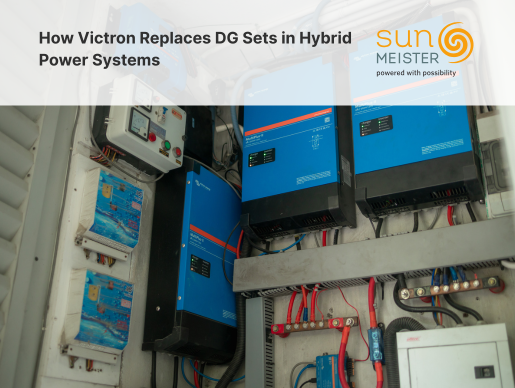
Diesel generator (DG) sets have been the default “backup plan” for decades, especially at remote sites, factories, commercial buildings, farms, and telecom towers. But they’re noisy, fuel-hungry, maintenance-heavy, and inefficient when run at low loads (which is most of the time in real life).
A modern hybrid power system flips the logic: solar + batteries handle daily energy, and a DG set becomes optional, only for rare peak demand or long low-sun periods. In many cases, Victron-based hybrid systems reduce DG runtime so dramatically that the DG set can be removed entirely.
Let’s break down exactly how.
What a Hybrid Power System Really Needs (And Why DG Sets Were Used)
A hybrid system typically juggles:
Variable generation (solar)
Variable demand (loads change every minute)
Reliability requirements (power can’t drop)
Battery protection (avoid overcharge/deep discharge)
Fast response to sudden load spikes (motors, pumps, compressors)
DG sets were used because they provide:
Instant high power (starting current)
Long-duration energy (as long as fuel is available)
“Simple” control (turn on when power is needed)
But DG sets also bring problems:
Fuel cost + logistics
Poor efficiency at partial load
Regular servicing, breakdown risk, spares, oil, filters
Noise, fumes, carbon emissions
This is where Victron’s inverter/charger + system control approach changes the game.
How Victron Replaces a DG Set: The Core Idea
Victron doesn’t “replace fuel.” It replaces the role the DG set plays in the system.
In a Victron hybrid design:
Solar produces energy first (lowest running cost).
Batteries store surplus solar for evening/night.
Victron inverter supplies loads with stable AC power.
When demand spikes, the inverter responds instantly.
If batteries get low, the system can start a generator only if needed, and in many setups, size and runtime are reduced so much that the generator becomes unnecessary.
The 6 Key Ways Victron Eliminates the Need for a DG Set
1) Instant Power for Load Spikes (Motor Starts, Surges)
A common reason sites keep DG sets is starting current for pumps, compressors, elevators, and machinery.
Victron inverters respond in milliseconds and can provide:
High surge power
Stable frequency and voltage
Clean sine wave (safe for sensitive electronics)
So instead of starting a DG set for a 10-second surge, the inverter + battery handles it quietly.
2) “Battery-First” Operation Cuts Generator Runtime to Nearly Zero
In DG-based setups, people often run the generator longer than necessary because:
They want to charge batteries
They want to “be safe”
They don’t trust the system to manage energy automatically
Victron systems are built for smart energy flow:
Solar charges batteries daily
Batteries supply loads through the inverter
The system uses priority rules (solar → battery → grid/genset)
Result: Generator runtime collapses from hours/day to occasional minutes or none.
3) Generator Is Most Inefficient at Low Load, Victron Fixes That
DG sets burn fuel even when lightly loaded. That’s why many sites waste fuel running a DG set just to cover small loads (lights, fans, routers, offices).
Victron replaces that low-load generation with:
Inverter-supplied AC from batteries
Solar handling daytime loads directly
If a generator is still present, Victron can run it only when:
Batteries need bulk charging
Loads are high enough to keep DG operation efficient
So even when not fully eliminated, the DG set becomes a “high-efficiency tool,” not a daily necessity.
4) Reliable Power Quality (A Big Hidden DG Problem)
DG sets can cause:
Frequency swings
Voltage dips during load changes
Harmonics and unstable output with sensitive electronics
Victron inverters provide stable output and can “buffer” bad power:
Loads see clean, stable AC
Batteries absorb sudden changes
The system rides through transitions without flicker
This matters hugely in:
Telecom
Medical equipment
IT rooms
CNC/automation environments
5) Smart System Control (Automatic Decisions, Remote Monitoring)
A hybrid system succeeds when it’s managed, not guessed.
Victron systems (with monitoring/control) let you:
Set battery SOC limits
Prioritize solar usage
Schedule heavy loads
Track energy history (solar yield, battery cycles, load peaks)
Detect issues early (bad battery, poor solar, unusual consumption)
This is how you move from “run generator just in case” to data-driven energy management.
6) Scalability: Grow Solar and Storage Instead of Fuel Bills
A DG set scales by burning more diesel. A Victron hybrid scales by:
Adding panels (more generation)
Adding batteries (more autonomy)
Increasing inverter capacity (more peak power)
Over time, most sites find it easier to invest in hardware once than keep paying for fuel forever.
Typical Scenarios Where Victron Can Replace DG Sets Completely
Telecom / Remote Sites
Small-to-medium continuous load
High reliability needed
Solar + batteries can cover daily demand
Generator becomes unnecessary if storage is sized correctly
Farmhouses / Rural Homes
Daytime solar runs appliances
Batteries cover nights
Inverter handles motor surges (water pump)
DG set often removed after 1–2 seasons of confidence
Shops, Offices, Clinics
Peak loads are predictable
Solar offsets daytime work hours
Battery backup covers outages and evening loads
Quiet, clean power is a big plus
Industrial Sites With Scheduled Loads
If machinery runs in planned blocks
System can be sized for surge + runtime
Generator becomes “rare emergency only” and often removed later
When a DG Set Might Still Be Useful (Even With Victron)
Victron can reduce generator use massively, but sometimes keeping a DG set as an emergency layer makes sense:
Very high continuous loads with low solar space
Long monsoon/low-sun seasons with high energy demand
Sites where downtime is extremely expensive
Extremely cold areas (battery performance constraints)
Even in these cases, Victron typically enables:
Smaller generator size
Fewer running hours
Better fuel efficiency
Longer generator life
Design Tips to Replace a DG Set Successfully
If your goal is “DG-free,” focus on these:
Size the battery for autonomy
Don’t design only for “backup minutes”, design for real hours.
Size the inverter for surge
Pumps and compressors need headroom.
Oversize solar slightly
Helps recover batteries faster and handles seasonal dips.
Use load planning
Run heavy loads in sunlight hours whenever possible.
Monitor everything
Energy data prevents under-sizing and surprises.
Final Thought: DG Sets Are Backup. Victron Makes Backup Optional.
A DG set is a mechanical solution to an energy management problem. Victron-based hybrid systems solve the same problem with:
fast inverter power,
smart battery usage,
solar-first energy flow,
stable power quality,
monitoring and control.
For many sites, this combination reduces generator usage so much that the DG set becomes unnecessary, not because power needs vanish, but because the system becomes smart enough to meet them without diesel.