
Running an air conditioner on solar and battery power is possible with the right system design. With rising electricity costs and increasing demand for reliable backup power in India, many homeowners and businesses are exploring solar-powered air conditioning as an alternative to depending entirely on grid electricity or diesel generators.
An air conditioner is one of the more energy-intensive appliances in a home or commercial building. Unlike lights, fans and televisions, an AC can consume a substantial amount of electricity over several hours. It also has compressor starting and operating requirements that must be considered when selecting an inverter and battery.
A properly designed solar and battery system can operate an air conditioner during the day using solar generation and continue running it after sunset using stored battery energy.
In this guide, we explain how to run an AC on solar and battery power, how many solar panels and batteries you may need, how to size the inverter and how Victron Energy technology can help build a reliable system.
Can You Run an AC on Solar and Battery Power?
Yes. You can run an air conditioner using a combination of solar panels, batteries and a suitable inverter system.
The system works by generating electricity through solar panels, converting it into usable AC power and storing surplus energy in batteries for later use.
A typical solar-powered AC system includes:
Solar panels to generate electricity.
Solar charge controllers or compatible solar inverter equipment to manage solar energy.
Batteries to store electricity.
An inverter to supply AC power to the air conditioner.
Protection equipment, cabling and monitoring devices.
Grid or generator backup, if required.
During the day, solar energy can directly support the AC load. Any available surplus energy can charge the batteries. At night or during cloudy conditions, the batteries supply the electricity required to operate the air conditioner.
The exact arrangement depends on the system architecture. In a hybrid installation, the grid can also support the load or charge the batteries when necessary.
How Does a Solar and Battery System Run an Air Conditioner?
A solar-powered air conditioning system uses several components working together.
1. Solar Panels Generate Electricity
Solar panels convert sunlight into DC electricity.
The amount of energy generated depends on:
Total solar panel capacity
Sunlight availability
Panel orientation and tilt
Shading
Temperature
System losses
During strong sunlight, the solar array can supply a significant part of the air conditioner’s electricity requirement.
2. The Solar Charge Controller Manages Battery Charging
A solar charge controller regulates the electricity flowing from the solar panels to the battery.
MPPT (Maximum Power Point Tracking) charge controllers optimise the operating point of the solar panels to extract available power under changing sunlight conditions.
For systems using separate solar charge controllers and inverter/chargers, the charge controller manages solar battery charging while the inverter supplies AC electricity to the air conditioner.
3. The Battery Stores Excess Solar Energy
When solar generation exceeds the immediate electricity demand, the surplus can be used to charge the battery.
The stored energy can later operate the air conditioner when solar generation falls or stops.
Lithium batteries, particularly LiFePO4 technology, are often considered for applications requiring regular charging and discharging. Lead-acid batteries can also be used in suitable systems, but their usable capacity and operating limits need to be considered.
4. The Inverter Supplies AC Power
Solar panels and batteries provide DC electricity, while most household and commercial air conditioners operate on AC electricity.
An inverter converts DC power into AC power suitable for the air conditioner.
The inverter must be sized to handle the AC’s running power, compressor starting requirements and any other appliances operating at the same time.
5. Monitoring Helps Manage Energy Consumption
Monitoring allows users to understand how much electricity the AC consumes, how much solar energy is generated and how much battery capacity remains.
This information helps manage operating schedules and avoid unnecessary battery discharge.
How Much Electricity Does an Air Conditioner Consume?
The electricity consumption of an AC depends on its capacity, energy efficiency, operating temperature, room insulation, outdoor temperature and usage pattern.
The following figures are illustrative estimates, not fixed consumption values.
| AC capacity | Approximate average running power | Energy used in 8 hours |
|---|---|---|
| 1 ton | 0.7-1.0 kW | 5.6-8 kWh |
| 1.5 ton | 1.0-1.5 kW | 8-12 kWh |
| 2 ton | 1.4-2.0 kW | 11.2-16 kWh |
Actual consumption can be lower or higher depending on the model and operating conditions.
An inverter AC may reduce its compressor speed once the desired room temperature is reached. This can reduce average electricity consumption compared with a compressor that repeatedly switches on and off, although actual savings depend on the conditions.
Important: Do not size a solar system using only the AC’s tonnage. Check the manufacturer’s rated input power, maximum input power, operating current and actual energy consumption.
Example: Solar System Required to Run a 1.5 Ton AC
Consider a home that wants to operate a 1.5 ton inverter AC for eight hours per day.
Assume the AC consumes an average of 1.2 kW while operating.
Daily energy consumption:
1.2 kW × 8 hours = 9.6 kWh
The system must generate and store enough electricity to meet this requirement while also accounting for inverter losses, battery charging losses and other system consumption.
1. Solar Panel Requirement
Assume the location receives an average of five peak sun hours per day.
For illustration, assume an overall system performance factor of 75%.
Required solar capacity:
9.6 kWh ÷ (5 hours × 0.75) = 2.56 kW
This is the theoretical solar capacity needed to generate approximately 9.6 kWh under the assumed conditions.
However, this calculation does not yet account for all the energy needed to charge the battery and cover additional system loads. A practical design may require a larger array, particularly if the AC must operate for several hours after sunset.
A solar array in the range of approximately 3.5-4.5 kWp could be a starting point for detailed evaluation in this example, subject to location, season, shading and operating schedule.
2. Battery Capacity Requirement
Suppose the AC needs to operate for four hours at night.
At an average consumption of 1.2 kW:
1.2 kW × 4 hours = 4.8 kWh
Assume a lithium battery with 90% usable depth of discharge and an inverter efficiency of 92%.
Required nominal battery capacity:
4.8 kWh ÷ (0.90 × 0.92) = approximately 5.8 kWh
This is a simplified estimate. The actual battery bank should also consider temperature, battery operating limits, discharge current, ageing and other connected loads.
3. Inverter Requirement
The inverter must be able to support the air conditioner’s operating power and any compressor starting demand.
For this example, a suitably selected inverter may need to support the AC load along with other appliances.
Check:
Continuous output rating
Surge power capability
AC voltage and frequency
Output waveform
Maximum operating temperature
Battery voltage and current requirements
Compatibility with the AC and other connected loads
A qualified system designer should confirm the exact inverter model and configuration before installation.
How Many Solar Panels Are Needed to Run an AC?
The number of solar panels depends on the total solar capacity required and the wattage of each panel.
For example, consider a solar array of 4 kWp using 550 W panels.
4,000 W ÷ 550 W = approximately 7.3 panels.
You would therefore need eight 550 W panels to provide approximately 4.4 kWp of installed capacity.
The actual number of panels should be determined by the inverter or charge controller’s PV input limits, available roof space, string voltage and solar generation requirements.
If you want to operate the AC at night, the solar system must generate enough additional electricity during the day to charge the battery as well as meet daytime consumption.
How Many Batteries Are Needed to Run an AC?
The number of batteries depends on the AC’s consumption, required backup duration, battery voltage and usable capacity.
For example, if a system requires 4.8 kWh of usable energy for four hours of AC operation, a battery bank must provide at least that amount after accounting for inverter losses and recommended depth of discharge.
Consider these factors:
Total energy consumption in kWh
Required number of backup hours
Battery chemistry
Nominal and usable battery capacity
Maximum continuous discharge current
Battery management system limits
Inverter efficiency
Future expansion requirements
Lithium batteries are often suitable for AC backup systems because they can provide high usable energy and support regular cycling when correctly designed.
However, the battery’s continuous discharge rating is just as important as its energy capacity. A battery may have sufficient kWh capacity but still be unable to deliver the required power if its discharge-current limit is too low.
Can You Run an AC Directly on Solar Panels Without Batteries?
Yes, in some solar system configurations, an AC can operate during daylight hours without battery storage.
A grid-connected solar system can use solar generation to reduce the electricity drawn from the grid. The grid supplies any additional power required when solar generation is insufficient.
Some specialised solar AC systems are also designed to operate with solar power and limited or no battery storage.
However, a conventional grid-tied solar inverter generally shuts down during a grid outage for safety reasons. Therefore, it cannot automatically provide backup power during a power cut unless the system includes suitable backup functionality.
If you want to run an AC during power cuts or after sunset, a battery-based hybrid or off-grid system is generally more appropriate.
Which Type of Solar System Is Best for Running an AC?
There are three main system configurations to consider.
1. On-Grid Solar System
An on-grid solar system is connected to the electricity grid.
During the day, solar generation supplies the AC and other connected loads. If solar generation is insufficient, the grid supplies the difference.
Advantages:
Can reduce electricity consumption from the grid
Usually does not require batteries
Lower initial cost compared with many battery-based systems
Suitable for homes and businesses with reliable grid access
Limitations:
Standard grid-tied systems generally stop operating during a grid outage.
Does not provide independent night-time backup without storage.
Solar generation depends on sunlight availability.
2. Hybrid Solar System with Battery Backup
A hybrid solar system combines solar panels, batteries, grid electricity and an inverter or inverter/charger.
During the day, solar power can run the AC and charge the batteries. At night, the batteries can supply electricity to the AC.
Advantages:
Can provide backup during grid outages
Stores surplus solar energy
Offers flexibility in managing solar, battery and grid power
Can support selected essential loads
Limitations:
Higher initial investment than a basic grid-tied system
Requires appropriate battery sizing
Needs careful system configuration and monitoring
For homes and businesses that want to run an AC during power cuts and after sunset, a hybrid solar system is often worth considering.
3. Off-Grid Solar System
An off-grid system operates independently of the electricity grid.
It uses solar panels, batteries and inverter equipment to provide electricity.
Advantages:
Suitable for locations without reliable grid access
Can provide independent electricity
Supports remote homes, farms and commercial installations
Can be designed for continuous operation with adequate solar and battery capacity
Limitations:
Requires careful solar and battery sizing
Higher battery capacity may be necessary
Must account for cloudy weather and seasonal solar variations
May need a generator for additional backup
Off-grid systems are particularly relevant for farms, remote properties, resorts, industrial facilities and locations where grid availability is limited.
Why Inverter Selection Is Important for Running an AC
An air conditioner places a significant load on the inverter. Selecting an undersized inverter can result in overloads, shutdowns or unreliable operation.
The inverter should be selected based on the AC’s electrical specifications, not just its tonnage.
Important considerations include:
Continuous power rating: The inverter must support the AC’s operating power.
Surge capacity: The inverter must handle starting or transient loads. Inverter ACs may have variable compressor operation, but their electrical input requirements still need to be checked.
Battery voltage: The battery bank and inverter must have compatible voltage ratings.
Charging capability: The inverter/charger or solar charge controller should support the battery’s recommended charging current.
Other connected loads: Include refrigerators, lights, fans, pumps and other appliances when calculating the total system requirement.
Operating temperature: Inverters may deliver reduced output at higher ambient temperatures, so installation conditions matter.
Why Consider Victron Energy for Running AC on Solar and Batteries?
Victron Energy offers a range of inverter/chargers, solar charge controllers, batteries and monitoring products that can be integrated into hybrid and off-grid solar systems.
Its modular architecture allows system designers to configure solutions according to the AC load, battery capacity, solar generation and backup requirements.
Some important Victron product categories include:
1. Victron MultiPlus and MultiPlus-II
The MultiPlus and MultiPlus-II are inverter/chargers that combine DC-to-AC power conversion with battery charging.
They can be used in suitable hybrid and off-grid configurations to supply AC loads and manage battery charging.
2. Victron Quattro
The Quattro is an inverter/charger designed with multiple AC inputs.
It can be useful in applications where different AC power sources, such as grid and generator supply, need to be integrated into the system.
3. Victron SmartSolar MPPT
SmartSolar MPPT charge controllers manage electricity generated by solar panels and optimise battery charging.
They are an important part of solar systems that use separate solar charge controllers and inverter/chargers.
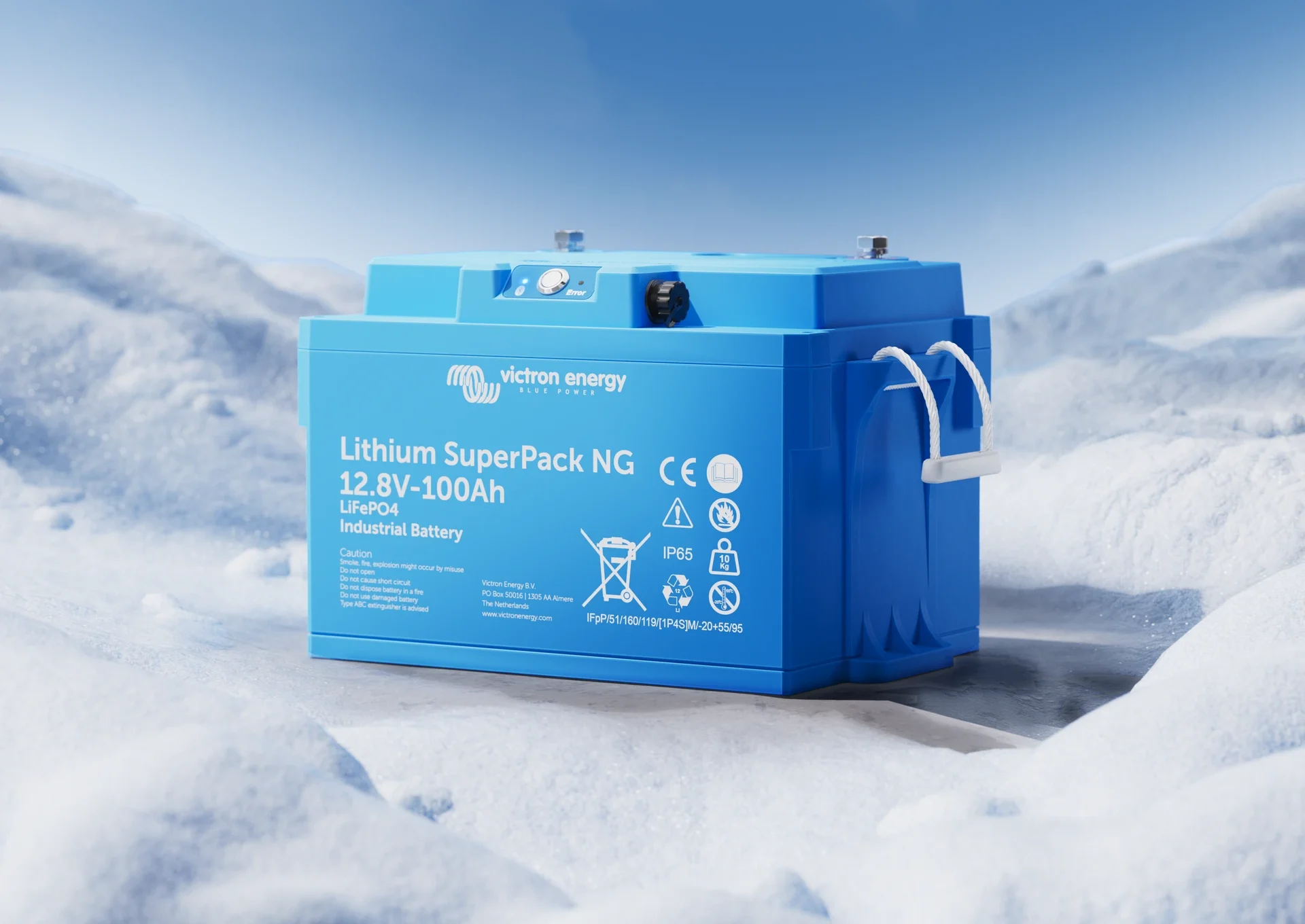
4. Victron Lithium Batteries
Victron offers lithium battery options for suitable energy storage systems.
The correct battery configuration depends on the required energy capacity, discharge power, system voltage and compatible battery management equipment.
5. Victron Cerbo GX and VRM Monitoring
The Cerbo GX provides system communication and monitoring capabilities for supported Victron equipment.
Victron Remote Management (VRM) allows users and authorised service teams to monitor compatible systems remotely, helping them review solar production, battery status, AC consumption and system performance.
For a solar-powered AC installation, monitoring is useful for understanding energy consumption and identifying whether the system has sufficient solar generation and battery capacity.
How Sunmeister Can Help You Run AC on Solar and Battery Power
Running an AC on solar and battery power requires more than installing solar panels and connecting a battery.
The system must be designed around the air conditioner’s electrical requirements, operating hours, battery backup needs, available roof space and local solar conditions.
Sunmeister Energy specialises in hybrid and off-grid solar power solutions for homes, farms, businesses, industries and remote locations across India.
Sunmeister is India’s authorised Victron Energy distributor, installer and repair centre. It provides complete energy solutions, including:
Assessment of AC power consumption and connected loads
Solar panel capacity planning
Battery sizing and integration
Victron inverter/charger selection
Solar charge controller integration
System design and installation
Commissioning and testing
Remote monitoring
Maintenance and technical support
With more than 12 years of experience and over 500 installations, Sunmeister focuses on designing systems around actual site requirements.
Whether you want to operate one AC in your home, multiple air conditioners in a commercial building or cooling equipment in a remote facility, Sunmeister can help evaluate the required solar and battery configuration.
Frequently Asked Questions
1. Can I run a 1.5 ton AC on solar power?
Yes. A 1.5 ton AC can operate on solar power with a suitably sized solar array and inverter. If you also want to operate it at night or during power cuts, you will need an appropriately sized battery system or another available power source.
2. How many solar panels are required to run a 1.5 ton AC?
The number depends on the AC’s actual electricity consumption, panel wattage, sunlight availability and operating hours.
As an illustrative starting point, a 3.5-4.5 kWp solar array may be considered for a 1.5 ton AC with moderate daily usage, but the final design must account for battery charging, system losses and other connected loads.
3. Can I run an AC on battery power at night?
Yes. A battery can supply electricity to an inverter, which converts DC power into AC electricity for the air conditioner.
The battery capacity must be calculated based on the AC’s average consumption and the number of hours it needs to operate.
4. How much battery capacity is required to run an AC for 8 hours?
Battery capacity depends on the AC’s average power consumption.
For example, if an AC consumes an average of 1.2 kW, eight hours of operation requires approximately 9.6 kWh of AC energy. The battery bank must have additional nominal capacity to account for inverter losses and recommended battery discharge limits.
5. Can I run two ACs on one solar system?
Yes. A solar and battery system can operate multiple ACs if the inverter, solar array and battery bank are designed for their combined loads.
The design should account for simultaneous operation, starting requirements, total daily consumption and backup duration.
6. Is a lithium battery better for running an AC?
Lithium batteries, particularly LiFePO4 batteries, can be suitable for AC applications because of their usable capacity and cycle-life characteristics. However, the battery must support the required continuous discharge current and be compatible with the inverter.
7. Can solar panels run an AC during a power cut?
A standard grid-tied solar system generally cannot supply electricity during a grid outage. A suitably configured hybrid or off-grid system with backup functionality can operate an AC during a power cut.
8. Can Victron Energy systems run air conditioners?
Yes. Suitable Victron inverter/chargers can be integrated into solar and battery systems designed to operate air conditioners. The correct model and configuration depend on the AC’s electrical requirements and the complete system load.
9. Does Sunmeister provide solar AC solutions in India?
Yes. Sunmeister designs and integrates hybrid and off-grid solar systems that can support air conditioners and other electrical loads. Its services include Victron equipment supply, system design, installation, remote monitoring and technical support.
Conclusion
Running an air conditioner on solar and battery power is achievable with the right system design. Solar panels generate electricity during the day, batteries store surplus energy and a suitably sized inverter supplies AC power to the air conditioner.
The most important factors are the AC’s actual energy consumption, solar panel capacity, battery storage, inverter power rating and required backup duration.
For homes and businesses looking for dependable air conditioning during power cuts or after sunset, a properly designed hybrid or off-grid system can provide a practical solution.
Victron Energy offers an integrated range of inverter/chargers, solar charge controllers, batteries and monitoring products for suitable applications. With Sunmeister’s system design, installation and technical support, customers can explore complete solar-powered AC solutions.
Want to run your air conditioner on solar and battery power? Contact Sunmeister Energy to assess your AC load and design a suitable Victron-based solar and battery system.