
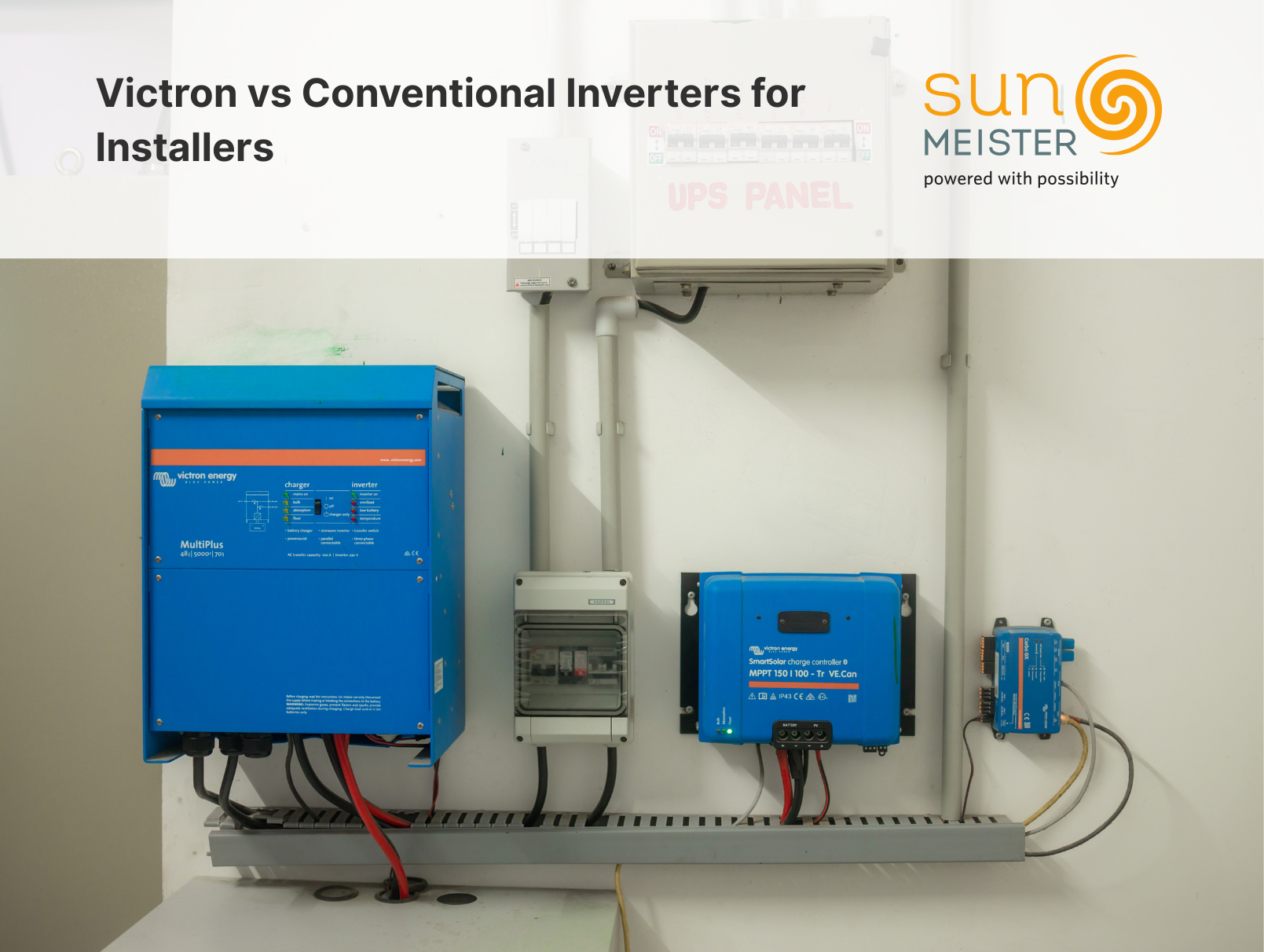
As the solar and power backup market matures, installers are increasingly facing customers who demand more than basic inverter backup. Today’s systems must support solar integration, battery storage, generator backup, and uninterrupted power during grid failure.
Choosing the right inverter technology directly impacts system reliability, installation success, and long term customer satisfaction. This is where the difference between Victron inverters and conventional inverters becomes important for installers to understand.
Understanding Conventional Inverters
Conventional inverters are commonly used for basic power backup applications. They are typically designed to:
Charge batteries when grid power is available
Supply power during outages
Support limited solar integration
While suitable for simple residential use, they have several limitations when applied to modern energy requirements.
Limitations of Conventional Inverters
Installers often encounter challenges such as:
Delayed changeover during power cuts
Limited support for solar and batteries together
Poor performance with motor loads
Restricted battery brand compatibility
Inability to integrate generators effectively
Minimal monitoring and diagnostics
These limitations lead to customer complaints and repeated service calls.
What Makes Victron Inverters Different
Victron inverters are designed as advanced energy management systems rather than simple backup devices.
They actively control and optimize power flow between:
Solar energy
Battery storage
Grid supply
Generator input
Connected loads
This integrated architecture allows Victron systems to perform reliably under real world operating conditions.
Power Transfer and Continuity
Conventional inverters often cause momentary power interruptions when switching between grid and battery.
Victron inverters switch in milliseconds, ensuring:
No equipment shutdown
No PLC reset
No data loss
Continuous operation of sensitive loads
This is a major advantage in commercial and industrial installations.
Handling High Surge Loads
Motor starting current is a common failure point in conventional inverters.
Victron inverters provide high surge capacity, allowing them to start and run:
Borewell and irrigation pumps
Compressors
Refrigeration units
Conveyors and mixers
Installers can avoid excessive inverter oversizing while still ensuring reliable operation.
True Hybrid Operation
Conventional inverters often operate in either solar mode or backup mode.
Victron inverters operate as true hybrid systems, enabling simultaneous use of:
Solar power
Batteries
Grid supply
Diesel or gas generators
The system automatically prioritizes the most efficient energy source without manual switching.
Battery Compatibility
Most conventional inverters are limited to specific battery types or brands.
Victron supports:
Lithium iron phosphate batteries
Tubular lead acid batteries
AGM and gel batteries
This flexibility allows installers to design systems based on availability, budget, and performance needs.
Generator Integration
Generator compatibility is limited or manual in conventional inverter setups.
Victron offers advanced generator support including:
Automatic start and stop
Battery based triggering
Load based generator control
Reduced generator run time
This significantly lowers fuel consumption and improves system efficiency.
Monitoring and Diagnostics
Conventional inverters usually provide only basic display information.
Victron systems offer advanced monitoring that includes:
Real time power flow
Solar generation data
Battery health and status
Load consumption history
Remote diagnostics
Installers can identify issues quickly and reduce site visits.
Scalability and System Expansion
Conventional inverters are difficult to scale and often require full replacement when load increases.
Victron systems are modular and scalable. Installers can add:
More inverters in parallel
Three phase configurations
Additional batteries
Expanded solar capacity
This allows future system upgrades without replacing existing equipment.
Installation Flexibility
Victron systems support a wide range of installation types:
Off grid systems
Grid interactive systems
Hybrid solar systems
Generator hybrid installations
Installers can use the same product platform for multiple applications.
Reliability and Continuous Operation
Conventional inverters are often designed for limited backup duty cycles.
Victron inverters are engineered for continuous operation in demanding environments such as factories, telecom sites, and remote installations.
This results in longer system life and fewer failures.
Comparison Summary for Installers
Victron inverters provide:
Faster and seamless changeover
High surge load handling
True hybrid functionality
Battery and generator flexibility
Advanced monitoring
Modular system expansion
Industrial grade reliability
Conventional inverters are suitable mainly for basic backup needs with limited scalability.
Business Advantages for Installers
By offering Victron systems, installers gain:
Access to higher value projects
Reduced service complaints
Improved customer satisfaction
Strong brand credibility
Long term upgrade and maintenance opportunities
This helps installers move from low margin installations to solution based projects.
Conclusion
For installers, the choice between Victron and conventional inverters goes far beyond price. It affects system reliability, customer trust, and business growth.
Conventional inverters may work for basic backup, but modern energy needs require hybrid functionality, battery storage integration, and intelligent power management.
Victron inverters deliver these capabilities through proven technology, flexible design, and long term reliability. As the market shifts toward hybrid and storage based systems, installers who adopt Victron technology position themselves ahead of the curve with solutions that truly meet customer expectations.